
Reflecting Without Regret: Year-End Journaling Prompts for Trauma Healing
Barb Dorrington
12/22/20252 min read
As the year comes to an end, many people naturally begin reflecting on the past twelve months—what they accomplished, what they lost, and how they grew. But for trauma survivors, reflection can feel intimidating. Looking back may bring up pain, disappointment, or moments you’d rather forget.
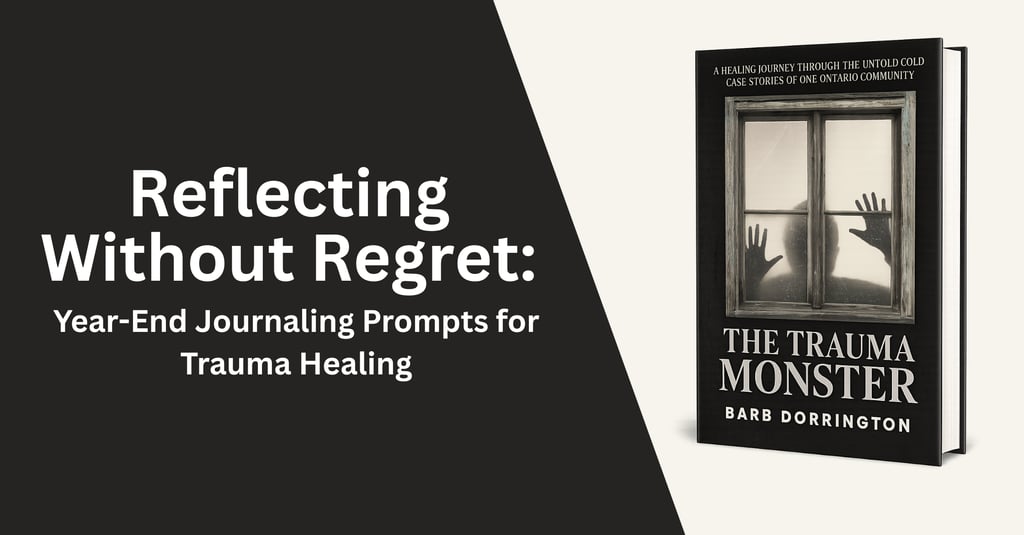
In The Trauma Monster, Barb Dorrington encourages survivors to approach reflection gently, without judgment or pressure. The goal isn’t to analyze every moment—it’s to honor your journey, your resilience, and the self who made it through another year.
This kind of reflection isn’t about regret—it’s about recognition.
Why Reflection Can Be Hard for Trauma Survivors
Trauma shapes memory. It can make the past feel blurry, shameful, or overwhelming. It can also make survivors hyper-critical of themselves.
Reflection becomes easier—and healing—when it’s done with compassion, curiosity, and safety.
Instead of asking, “What did I fail at?” or “Why did I struggle so much?” shift to gentler questions like: - What did I survive? - What did I learn about myself? - Where did I show courage?
Your reflection doesn’t have to be polished. It doesn’t have to be positive. It only needs to be honest.
Year-End Journaling Prompts for Healing and Growth
Use these prompts to guide a peaceful, grounding reflection—one that centers growth rather than regret.
1. What is one thing I’m proud of surviving this year?
Even if it feels small, surviving is worth celebrating.
2. What moment this year made me feel safe, calm, or seen?
These glimpses—known as “glimmers”—are important markers of healing.
3. What did I learn about my needs, boundaries, or triggers?
Healing is often revealed through self-awareness.
4. What is something I let go of this year (even if it was painful)?
Letting go is a quiet, powerful form of growth.
5. What part of myself am I beginning to understand better?
Maybe your inner child. Maybe your nervous system. Maybe your emotions.
6. What relationship (with myself or others) became healthier this year?
Progress in connection is a meaningful sign of healing.
7. What was unexpectedly hard this year—and how did I care for myself through it?
This question highlights resilience rather than struggle.
8. What brought me comfort, joy, or grounding this year?
Lean into the things that soothed your nervous system.
9. What do I want more of next year?
Rest? Peace? Boundaries? Connection? Creative expression?
10. What message does my body want to carry with it into the new year?
Your body remembers both the hurts and the healing.
Reflection Is Not About Perfection
Your year doesn’t need to be neatly wrapped or beautifully summarized. The purpose of this practice is not to rewrite the past—it’s to acknowledge the strength it took to reach this moment.
In The Trauma Monster, Barb Dorrington reminds us that healing is a long, winding journey. Looking back with compassion allows you to see how far you’ve come—not through achievements, but through endurance, self-awareness, and courage.
This year, reflect in a way that honors your humanity. Honor the tears, the breakthroughs, the survival, and the quiet wins no one else saw.
You made it through another year. That alone is worth writing about.