The Trauma Monster
Cold cases. Untold trauma. One community's long wait for answers.
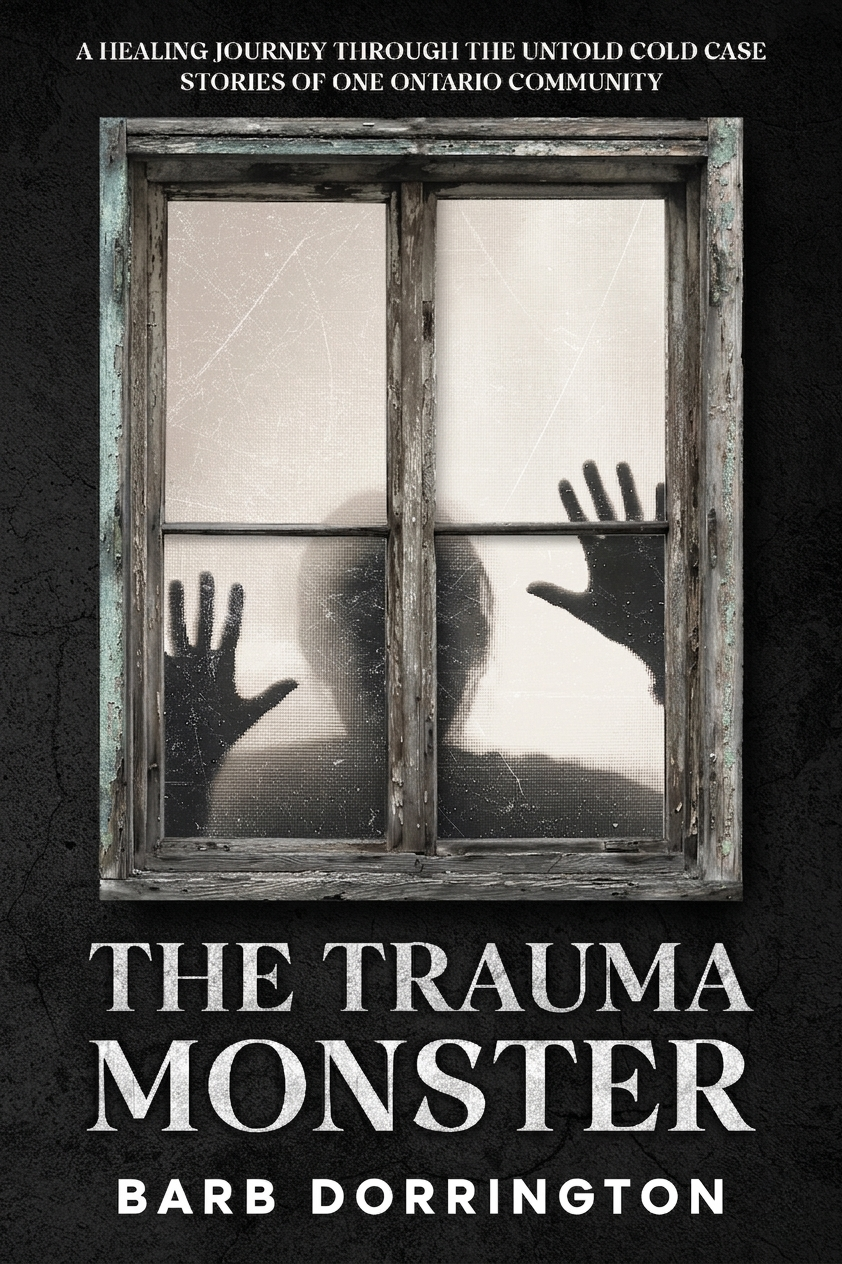
The Trauma Monster
A Healing Journey Through the Untold Cold Case Stories of One Ontario Community
In this deeply personal work, retired social worker and trauma art therapist Barbara J. Dorrington explores the unsolved cold cases of Southwestern Ontario and the profound trauma they left behind. Through first-person interviews and decades of therapeutic experience, Barb gives voice to those who have waited too long for answers, and too long to heal.
Read the First Chapter
Chapter 1
The Murder of Scott Leishman
The Leishman Family moved to a rural home just west of Thorndale, a village east of London. To me, Thorndale might as well have been on the moon. I still carried a torch for Scott and hoped I would see him occasionally at Walkerville Collegiate High School. But Scott was gone, and I felt an emptiness and a sense of foreboding that I would never see him again. Why did I pine for a boy I had never hugged or kissed? I couldn't explain it. Cathy stayed in touch with the Leishman twins, and visits continued between our home and theirs, at least for her. I would hear about Scott vicariously.
Things were changing for our family. Cathy became pregnant with Bob's child, and their son David was born just before her eighteenth birthday. My world was overturned when my parents separated. Then my brother Earl left for university, and Cathy and Bob purchased a house near the Windsor airport. Suddenly, it was just me and my mom, alone at home. As a single mother, my mom was forced to sell our house, and we moved into a small two-bedroom apartment on Tuscarora Street. I would go babysit for Cathy and catch up on news about the Leishman twins, still hoping to hear about Scott. The crush was still going strong.
When my nephew David was six months old, Cathy went to visit the Leishmans in Thorndale. The Leishman family home stood on a small hill at the corner of Medway and Valleyview Road, just a stone's throw from the Thames River. It looked like a two-story home, but since it was partially built into the side of a hill, it was a back-split. The long drive up to the house would be easy to miss if you were driving by, as it ran parallel to the river. Being a city girl, as she stood outside the Leishman home, it all seemed like fields, trees, and water to her. She loved the smell of the coming spring from the budding bushes. Inside was a comfortable and warm family home with bedrooms up a short flight of six stairs from the back door and a kitchen and living room on the main level. There was also a screened-in porch that held a bed, which is where Cathy stayed as a guest. For her, it was a beautiful retreat in the wilderness with two of her favorite girlfriends.
It was the end of March break in 1968, and she arrived on Friday, looking forward to a fun weekend stay. She arrived that day only to find out that Scott had gone missing the day before she arrived. No one knew where he was. His parents were sick with worry, searching for their son. For Cathy, it was a strange visit. They tried to have a fun weekend, telling themselves that Scott would show up at any minute, but he never came through the door. When she got home, she said that everyone was hopeful that Scott would return and that there must be a good reason for his disappearance.
The days dragged into weeks. Scott had vanished without a trace. I felt confused and lost by the sudden disappearance of my first crush. No one in Windsor was talking about Scott, no fellow students at school or anyone in the neighbourhood. It seemed the whole world was merrily moving along just fine without him, except for me. At least I had my mother to talk to. She liked the Leishman family and was worried about their missing son. It frustrated me to have to wait on my sister Cathy to get updates and answers.
My sister was thinking about returning to work now that my nephew David could be left with a babysitter. Before she did, she decided to visit the Leishman twins in Thorndale while she still had free time. Scott was still missing, but she believed she could offer her friends some much-needed distraction over the Victoria Day weekend of May 1968. Cathy had no idea what she was in for when she left her house and traveled to Thorndale. She went in through the mud room entrance as usual, where she was met by the twins, who had terrible news to share. Scott's body had been found.
Scott's body was discovered on May 15, 1968, in the Port Burwell Harbour. It had been more than a month since he disappeared. It took some time to identify him, so the family had only just received the news. The autopsy was clear: he had been thrown into the water, likely Big Otter Creek, unconscious, and he had drowned. His clothing was described as "disturbed" in reports, with his zipper undone and his pants awkwardly secured to hold them up, indicating he'd been redressed at some point. From the very beginning, the assumption was that he had been murdered.
Cathy was dumbfounded. She marveled at the calm composure of the family, sitting together quietly in the living room, occasionally wandering off to stare out a window. There was no screaming or wailing. There was just silence.
Later that day, Cathy's skin broke out in a rash of red, itchy bumps. In retrospect, it was probably a bout of stress-induced hives. Mrs. Leishman treated Cathy's skin lesions with aloe vera and cold compresses, making sure to comfort her. Cathy was grateful for the help but felt guilty that Mrs. Leishman treated her rash instead of sitting and mourning with her family. Still, maybe taking care of someone was a welcome distraction.
Cathy doesn't remember specific conversations that took place in the Leishman house that weekend, like theories about what happened to Scott. That wasn't important to her. She just wanted to support her friends and their family. It was a lot to process. Even though she was a wife and mother, she was only 18 years old. Cathy stayed with the Leishmans for the weekend. The family embraced her and wanted her there, even though the household was enveloped in a cloud of sadness.
Crushed and Curious
Meanwhile, I was at home in Windsor, sitting cross-legged on my bed with my journal. Using a pack of colored pens, I wrote about school, how my friend Lucy gave me a nasty look, how my mom expected me to always make my bed, and what movie I was going to see.
My mother walked into my room unannounced, her lips pursed and tears welling up in her eyes. She gingerly sat down on the edge of my bed, close to my feet. She reached out to touch my leg, thought better of it, and clasped her hands tightly together. My body tightened instinctively, and I wrapped my arms around myself in a hug, thinking I was in trouble again.
Mom started with, "Cathy called me."
I looked at her and wondered what Cathy might have said to make her look so upset.
She hesitated, her face distraught, and started again. "Cathy called me," she said.
This time I replied, "Yes?"
Mom let out a huge burst of air and said, "The police found Scott's body in the Port Burwell Harbour. They think he has been dead for quite a while, in the water. I don't know anything else."
"Was it an accident?" I asked. "Or was it murder?"
"Yes, they think it had to be murder. He was found in the water, far away from his home."
My mother waited for me to react.
There was a loud ringing in my ears. I remembered bumping into Scott downtown at the Nut House Candy Shop on Ouellette Street. He was buying caramel popcorn, and I was buying the store's signature red pistachios. I recalled his expressive mouth, open and laughing, his eyes twinkling with happiness. For a moment, I was there again, standing with Scott in the candy store, feeling the embarrassment of my crush and the joy of being with him. My cheeks reddened. Then the smell of caramel popcorn faded. All that was left was an intense, shooting pain in my solar plexus. Sitting still on my bed, I was suddenly breathless, like after running up a large hill. Sweat poured down the sides of my cheeks. My hand moved in slow motion as I picked up my red pen and wrote in large letters: "Scott was murdered."
My mother saw what I had written and left my bedroom, as she often did when she sensed I was sad or moody, but this time was different. She slowed her step significantly and looked back at me more than once before walking out the bedroom door.
It seemed like forever before my breathing returned to normal. I thought that nothing would ever feel normal again.
Over the years, when I thought about Scott, I remembered him in pretty much exclusively positive terms: his smile, his eyes, his popularity, his athleticism. My halcyon memories were reinforced by posts on the "If You Grew Up in Windsor" Facebook page. Many girls in our classes had a crush on him like I did and, as adults, remembered him fondly. My connection to Scott felt and still feels strong.
In 2024, I got in touch with Al, an old friend from high school. During our conversation, we laughed about how I kept grinding the gears when he taught me to drive stick shift. We'd been in an old blue Volkswagen bug, out at my sister Cathy's place while I babysat young David. Al was also a good friend of Scott's. They met in Boy Scouts and reminisced about those carefree days at the weekly Cub meetings in the basement of St. Barnabas Church. Al told me how he had gone to Mrs. Leishman's funeral when Marie Leishman died in September 2017. He believed he and Scott would have likely become good friends if Scott had remained in Windsor during high school. Talking to Al, I was comforted to know that my memory of Scott was accurate and not just a fantasy.
Back in 1968, the media coverage of Scott's case was remarkably restrained and almost muted compared to the extensive attention given to the disappearances of numerous other children in London and nearby communities during the late 1960s and 1970s.
There was a widespread understanding that Scott was picked up hitchhiking after he went fishing during March Break. One rumor suggested he may have hitchhiked all the way to Windsor at times to visit old friends. If people thought Scott was hitchhiking, there was an unspoken consensus that in a way he might have had it coming. Another rumor that Scott had simply run away might have also influenced the initial coverage. Runaway teens were seen as troublemakers who brought trouble upon themselves, an especially prevalent attitude in the late 1960s.
The media often favors stories about victims deemed more deserving, a phenomenon known as "Missing White Woman Syndrome," a term coined by journalist Gwen Ifill in 2004. Although there are exceptions, this principle may have contributed to the lack of coverage Scott's case received. He simply wasn't seen as deserving of the press, being a teenage boy who liked to hitchhike, or maybe just ran away.
Scott's abduction and murder occurred outside of London. In 1968, Thorndale had fewer than 500 residents and required its high school students to commute via school bus to Medway High School in London proper. People in Thorndale felt more kinship with communities like Arva and St. Mary's than with the Forest City. Consequently, the London media may not have seen Scott's case as London news.
In the end, Scott's story vanished rather quickly from newspaper reports and broadcasts. For those of us who remember him, there were no answers as to what happened. There was no resolution. It felt, in many ways, like a strange dream. That was unacceptable to me.
I've spent hours tracking down what little information I could about Scott's case from the London Free Press, newspapers in other cities, archives, and any other sources I could find, in an effort to put together a clear picture of what happened to him.
The weather conditions on March 21, the day he disappeared, were a mixture of rain and snow, with temperatures falling below the average of 3 degrees Celsius. Scott might have changed his fishing plans. Some theories suggest that Scott was fishing on the Plover Mills Bridge, north of his home, and that his killer threw him off that bridge, where he floated down the waterway to Port Burwell. However, conversations with residents who lived in Thorndale in 1968 suggest that Scott's immediate neighbourhood boasted the preferred fishing spots.
Other theories suggest Scott might have been at a part-time job that day, possibly on a farm or at a variety store. During that era, it was common for teenagers to come and go without checking in with their parents until suppertime. It's virtually impossible to pinpoint his movements that day, or where the abduction took place.
On March 23, a small article titled "Thorndale Youth Reported Missing" was published in the London Free Press. It provided a brief description of Scott: approximately 5'7" tall, weighing around 145 pounds, with dark hair. Scott's father, Gord Leishman, reported his son missing two hours after he failed to appear for supper. There was hardly any other media coverage until Thursday, May 16, 1968, when The London Free Press published an article titled "Unidentified body found floating face down in Port Burwell Harbour."
Six days after discovering Scott's body, on Wednesday, May 22, 1968, Dennis Alsop, the lead detective of the Ontario Provincial Police, held a press conference publicly revealing the name of the missing boy: sixteen-year-old Scott Leishman. That same day, it was reported that Scott's body had been cremated on May 21, 1968, and a private family memorial had taken place at St. George's Anglican Church in Thorndale. The memorial was for immediate family only. Cathy did not even know it had happened.
Police hoped that someone might remember seeing Scott based on a description of his clothing. An article published in The London Free Press on May 29th appealed to the public for information, specifically mentioning that Scott had been observed entering a white or ivory-colored, medium-sized compact car around 4 PM on the Thursday of March Break.
Contradictory statements in London Free Press articles are puzzling. Witnesses saw Scott in Thorndale on the day of his abduction getting into a car headed east, while another article stated he was seen getting into a car heading west. With so little press coverage or other information available, it's impossible to unravel the details surrounding Scott's disappearance.
That is what feeds my trauma monster.
Drawing a Trauma Monster
If I could go back to 1968, I wish someone would have asked me to draw my own trauma monster. Throughout my thirty years as a trauma art therapist, I watched many children carefully guide a pencil or marker in their tiny hands to draw pictures of their traumas as monsters. This was an instinctual way of symbolically controlling the monster by making it external to their body in the drawings. The act of externalizing the monster onto a piece of paper can provide a feeling of mastery over the beast.
Children often see their trauma monster as just one entity. For many of the children I spent time with as a therapist, they indeed had more than one monster, as they often came from backgrounds of poverty, neglect, or sexual abuse. As a therapist working with such a child, I would always recognize that the teacher or other figure was never as "bad" as depicted. However, if I could help the children begin to feel in control of their emotions and responses, it often eased them into talking about the other traumas that came earlier.
If I wanted to instill hope in a child that things could and would change, I would always ask a question that showed things would improve. After over 40 years of counselling experience, the basic tenet for me was always to start where the client was. It didn't matter if we were talking about the most serious problem; I knew that through building a relationship, we would eventually get to hope and healing.
Want to Keep Reading?
The full story of Scott Leishman and many others awaits. Pick up your copy of The Trauma Monster today.
Also Available as an Audiobook
Experience The Trauma Monster in audio — narrated and brought to life for listeners who prefer to hear the story unfold.
Face the Monster.
Order your copy of The Trauma Monster today and join Barb Dorrington as she reopens the cases that history tried to forget.